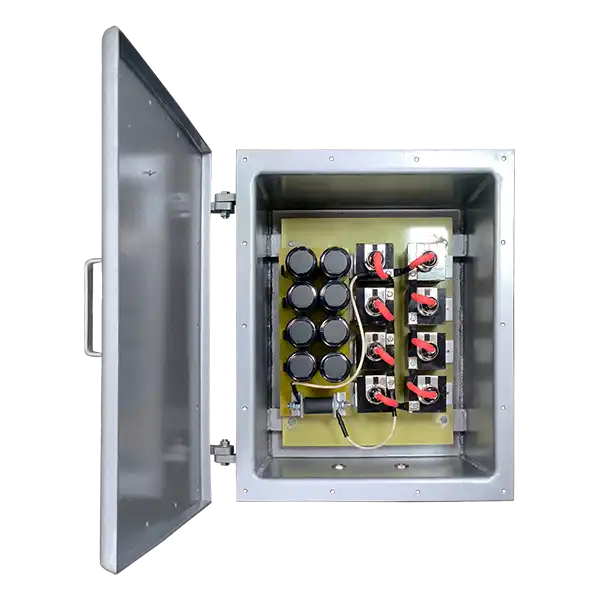
The protective threshold device (ZPU (Ex) SHIK) (hereinafter referred to as PU) is a method and means for protecting metal structures and equipment from corrosion and overvoltage during AC short circuits caused by lightning strikes or switching transients. The PU operates by utilizing a semiconductor switch and a capacitor connected in parallel. This design expands its scope of application, enabling simultaneous DC isolation of cathodic-protected equipment from the public power grid grounding system and protection of equipment from overvoltage during AC short circuits caused by lightning strikes and switching transients.
Operating principle.
The electrical circuit of the control unit is illustrated by drawings: in Fig. 1; in Fig. 2, a diagram explaining its operation.
The device contains a diode switch, electrically connected between the ground and the protected metal structure (main pipeline).
In the PU, the diode bridge is made using a counter-parallel connection scheme of diodes.
The PU additionally contains an electric capacitor (capacitance) connected in parallel to the diode bridge.

The PU works as follows.
The PU is used to provide AC grounding and DC isolation of electrical equipment of a main pipeline where electrochemical protection potential is present.
In the event of a short circuit of the equipment on the object, the control panel ensures its grounding.
ПУ используется для сброса напряжения переменного тока в магистральном трубопроводе, возникающего при коротком замыкании на землю линии электропередач, пересекающей магистральный трубопровод, то в этом случае ПУ подвергается воздействию переменного тока линии электропередачи.
В этом случае ПУ пропустит весь ток на землю с минимальной разностью потенциалов между входами. После устранения неисправности ПУ восстанавливается и переходит в нормальный режим работы, в котором пропускается установившийся переменный ток малого уровня (если таковой присутствует), и блокируется постоянный ток.
The PU is also used in the insulating joint to provide protection for equipment against overvoltage, lightning strikes, and AC short circuits. In this case, the PU protects the joint by passing the entire AC load through itself, bypassing the insulating joint, while limiting the voltage at the joint itself.
Once the short circuit or lightning strike is cleared, the device automatically returns to the normal DC blocking mode.
Figure 2 shows the operating ranges of the PU for direct current when providing electrochemical protection. In the range of direct voltages (-U limit…+ U limit), the main pipeline is blocked by direct current, and to the right and left of the specified range, the PU is shorted to ground.
For alternating current, the PU ensures constant electrical contact between the main pipeline and the ground.